

Table of Contents
- The Verdict: Is a Capsule Wardrobe Worth the Investment?
- Does a Capsule Wardrobe Actually Save Money?
- Investment Pieces for a Capsule Wardrobe
- How Many Clothes Should Be in a Capsule Wardrobe?
- Building a Capsule Wardrobe on a Budget
- Who Benefits Most From a Capsule Wardrobe
- The Trade-Offs: What You Might Miss
- Frequently Asked Questions
Last Updated: October 11, 2026
The Verdict: Is a Capsule Wardrobe Worth the Investment?
Whether is a capsule wardrobe worth the investment depends on whether you prioritize quality, durability, and intentional spending over fast fashion. The real question isn't whether capsule wardrobes save money, it's whether you're willing to spend more upfront to spend less overall. This approach works best for people tired of decision fatigue and impulse purchases, but it requires discipline and honest self-assessment about your lifestyle and budget.
The investment case rests on three pillars: cost per wear, reduced impulse buying, and the longevity of quality pieces. When you own fewer items that you actually wear, each piece works harder for your money. A $60 shirt worn 100 times costs 60 cents per wear. A $20 fast-fashion shirt worn five times before it falls apart costs $4 per wear. The math favors investment pieces, but only if you actually wear them.

The catch: building a capsule wardrobe requires upfront capital. You can't do it gradually on a tight budget. You need to buy multiple basics in different colors, invest in one or two statement pieces, and commit to a color palette before you see the savings. For someone living paycheck to paycheck, this model creates a barrier to entry that fast fashion doesn't have.
Does a Capsule Wardrobe Actually Save Money?
Yes, but the savings depend on your starting point and how disciplined you become. If you currently spend $100 per month on clothes you rarely wear, a capsule wardrobe will cut that dramatically. If you already shop intentionally, the difference will be smaller.
Research from McKinsey's consumer spending analysis shows that mindful shopping habits reduce overall apparel spending by 20-35% within the first year. The capsule approach accelerates this by removing the temptation to buy "just one more thing" because everything has to fit your existing collection.
Cost Per Wear: The Real Measure
Cost per wear is the only metric that matters when evaluating whether an investment piece is actually worth it. A $100 sweater worn 200 times costs 50 cents per wear. The same sweater worn 10 times costs $10 per wear. Most people underestimate how often they wear their favorites and overestimate how often they wear impulse purchases.
To calculate cost per wear: divide the price by the number of times you've worn it (or expect to wear it). Track this for three months. You'll likely discover that your most-worn items are also your most affordable per wear, even if they cost more upfront.
Reduced Impulse Purchases
The real savings come from what you don't buy. A capsule wardrobe forces you to think before purchasing. If a new item doesn't coordinate with at least three existing pieces, it doesn't belong in your collection. This simple rule eliminates most impulse buys.
According to American Psychological Association research on consumer behavior, impulse purchases account for 40-80% of all buying decisions. A capsule framework removes that decision-making burden by establishing clear criteria before you shop. You're not deciding whether to buy something in the moment, you've already decided what you need.
Investment Pieces for a Capsule Wardrobe
Investment pieces are the foundation of a capsule wardrobe. These are items you wear repeatedly across multiple seasons and occasions. They're usually neutral in color, timeless in style, and made from durable materials.
Quality Fabrics That Last
The difference between a $30 shirt and a $60 shirt often comes down to fabric quality and construction. Natural fibers like cotton, wool, and linen breathe better, age well, and hold their shape longer than cheap synthetics. Blended fabrics that combine natural fibers with a small percentage of spandex or polyester offer stretch and durability without sacrificing breathability.
WearWhatToday's Essential Tee, priced at $14, uses a 55% cotton, 40% modal, 5% spandex blend that maintains its shape through repeated washing. This fabric choice means the shirt stays comfortable and looks newer longer, key factors in cost-per-wear calculations.
When evaluating fabric quality, check the fiber content and weight. Heavier fabrics (measured in ounces per square yard) generally last longer. A 6-ounce t-shirt will wear out faster than an 8-ounce one. Natural fiber content matters too.
Timeless Design Over Trends
Trends fade. Timeless pieces stay relevant for years. A classic white button-up shirt, well-fitting dark jeans, and a neutral sweater will outlast any trend-driven purchase. This doesn't mean your wardrobe has to be boring, it means choosing pieces that work across multiple seasons and styles.
The WearWhatToday Crewneck Sweatshirt with minimal graphic design exemplifies timeless styling. At $54.99, the understated design means it won't feel dated. Trend-driven pieces (neon colors, bold logos, oversized silhouettes) feel fresh for a season, then sit unworn in your closet.

When shopping for investment pieces, ask: "Will I still want to wear this in five years?" If the answer depends on trends, it's not an investment piece. Neutral colors (black, white, gray, navy, cream, beige) work across more outfits and seasons than statement colors.
How Many Clothes Should Be in a Capsule Wardrobe?
There's no magic number, but most capsule wardrobes contain 30-50 pieces. This includes tops, bottoms, outerwear, and accessories, everything except workout clothes, pajamas, and special-occasion wear. The exact number depends on your climate, lifestyle, and work environment.
A professional who works in an office needs more structured pieces than someone who works from home. Someone in a cold climate needs more layering pieces than someone in a warm climate. A parent with young children needs more durable, easy-care pieces than someone without that responsibility.
Start by counting how many items you actually wear in a typical week. Most people rotate the same 10-15 pieces repeatedly. Those are your capsule foundations. Build from there by adding pieces that extend versatility, different textures, layers, and accessories that create new outfit combinations.
| Climate | Suggested Pieces | Rationale |
|---|---|---|
| Cold/Seasonal | 40-50 | Need layering basics, sweaters, outerwear |
| Warm/Year-Round | 30-40 | Fewer heavy pieces, more lightweight options |
| Mixed/Variable | 35-45 | Balance of layering and lightweight pieces |
Building a Capsule Wardrobe on a Budget
You don't need unlimited funds to build a capsule wardrobe. You need a plan and patience. The goal is to buy less frequently but more intentionally.
Start Small and Expand Intentionally
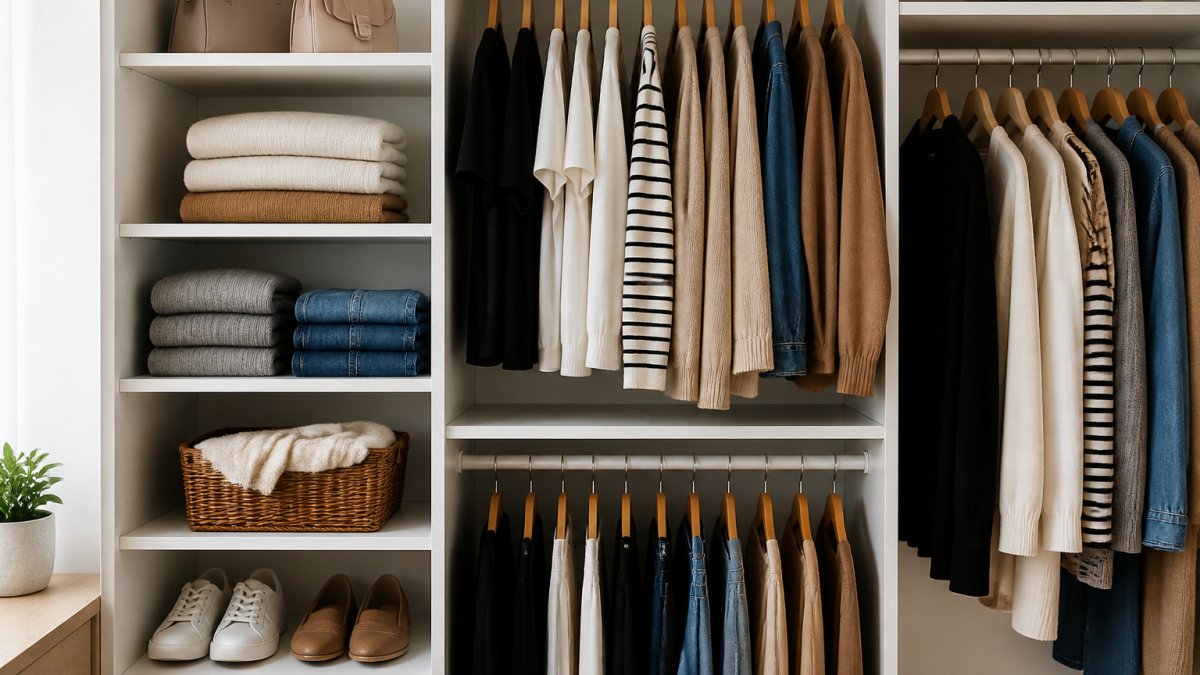
Begin with 10-15 basics in a consistent color palette. Choose three to five neutral colors that work together: black and white, navy and cream, gray and beige. Every piece you add should coordinate with at least three existing items. This constraint forces intentional buying.
Set a monthly budget and stick to it. Instead of buying one expensive piece, buy two or three basics. WearWhatToday's Unisex Cotton Crew Tee at $19.38 and Essential Tee at $14 are affordable starting points that layer well with other pieces. The goal is to build a foundation of basics before investing in statement pieces.
Choose Versatile Basics First
Basics are the backbone of a capsule wardrobe. These are neutral-colored, simple-styled pieces that work across multiple outfits: plain tees, simple sweaters, well-fitting jeans, neutral pants. Once your basics are solid, add one or two statement pieces that reflect your personal style.
The WearWhatToday V-Neck Tee at $34.32 offers more visual interest than a plain crew neck while remaining versatile enough to layer under sweaters or wear alone. The minimal graphic design means it works across casual and semi-professional settings. This is the type of piece that justifies slightly higher spending because it extends outfit combinations.
Build your basics first, statement pieces second. A common mistake is buying statement pieces before establishing a strong foundation. You end up with interesting items that don't coordinate with anything.
Who Benefits Most From a Capsule Wardrobe
A capsule wardrobe works best for people with consistent routines, limited time for shopping, and a preference for simplicity over novelty. If you wear a uniform to work, have a defined personal style, or hate shopping, this approach will save you time and money.
It's less effective for people who love fashion variety, frequently change styles, or enjoy the process of shopping. If you get genuine joy from discovering new trends and experimenting with different looks, forcing yourself into a capsule wardrobe will feel restrictive rather than liberating.
Busy professionals benefit significantly. When your wardrobe is small and coordinated, getting dressed takes minutes instead of 20 minutes of staring at options. Parents, people with demanding jobs, and anyone juggling multiple responsibilities appreciate this simplification.
People with limited closet space also benefit. A capsule wardrobe requires less storage and makes efficient use of small spaces. Instead of spreading 100 items across a closet, you're working with 30-50 pieces that all fit and all coordinate.
The Trade-Offs: What You Might Miss
A capsule wardrobe requires trade-offs. You sacrifice variety for simplicity, novelty for consistency, and impulse shopping for intentional purchasing. Understanding these trade-offs helps you decide if this approach actually fits your life.
You'll wear the same outfits more frequently. If you have five people who see you regularly (coworkers, family, friends), they'll notice you rotating the same pieces. This doesn't matter if you're comfortable with it, but it bothers some people.
Seasonal transitions become more noticeable. You can't completely refresh your look each season because you're working with the same pieces. This means your style evolves slowly rather than dramatically. For people who love seasonal fashion changes, this feels limiting.
The upfront investment is real. Before you see savings, you need to spend money on quality basics and investment pieces. If you're currently spending $50 per month on clothes, building a capsule wardrobe might require $500-800 upfront. That's 10-16 months of current spending compressed into a few weeks.
Finally, a capsule wardrobe requires self-knowledge. You need to understand your body, your lifestyle, your color palette, and your personal style before you can build one that actually works.
A capsule wardrobe is worth the investment for most people, but only if you approach it strategically. Start by identifying your actual lifestyle needs and color preferences. Shop our curated collection of wardrobe essentials and investment pieces designed to work together effortlessly. Shop New
Frequently Asked Questions
Does a capsule wardrobe actually save money over time?
Yes, when calculated by cost per wear. A £50 piece worn 100 times costs 50p per wear; a £15 trend piece worn 5 times costs £3 per wear. Capsule wardrobes reduce impulse purchases because every piece is intentional and coordinates with existing items. Most people spend less annually once their capsule is established, though the upfront investment is higher than fast fashion. The real savings emerge after 12-18 months.
How many clothes should be in a capsule wardrobe?
Most capsule wardrobes contain 30-50 pieces, though the right number depends on your climate, lifestyle, and work environment. Busy professionals who transition from office to evening plans may need more layering pieces, while others thrive with 20-30 essentials. Quality matters more than quantity. Start by auditing what you actually wear, then build around those core pieces. WearWhatToday's Essential Tee ($14) and Unisex Cotton Crew Tee ($19.38) are foundation pieces that multiply outfit combinations.
What investment pieces for a capsule wardrobe should I prioritize?
Invest in pieces that work across multiple seasons and occasions: well-fitting neutral basics, quality outerwear, and versatile layering items. Prioritise durability and fabric quality over brand names. WearWhatToday's Crewneck Sweatshirt ($54.99) uses a 50/50 cotton-poly blend with double-needle stitching that maintains shape after repeated washing, making it ideal for rotation. Choose neutral colours (black, white, grey, navy, beige) that coordinate easily. Avoid trendy cuts or colours that limit mixing and matching.
Can you build a capsule wardrobe on a budget?
Absolutely. Start with affordable basics: WearWhatToday's Essential Tee ($14) and Unisex Cotton Crew Tee ($19.38) form a strong foundation without breaking your budget. Buy one or two investment pieces per month rather than all at once. Focus on versatility and neutral colours so pieces work together. Avoid fast fashion that falls apart quickly; mid-range quality pieces worn frequently offer better value. Thrift or swap for occasional variety without adding cost. A functional capsule can expand gradually as your budget allows.